
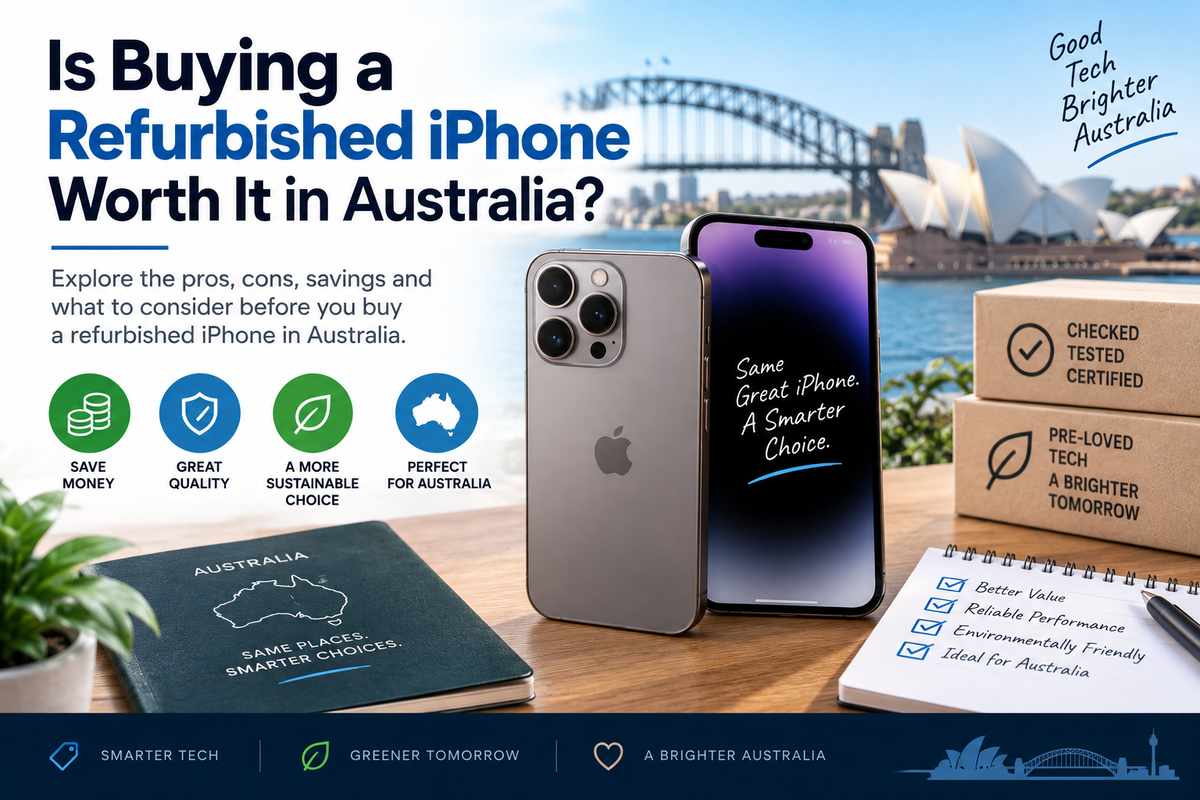
Walk into any phone conversation in Australia and someone will tell you refurbished is a bargain, while someone else will tell you it is a gamble. Both are right, depending entirely on who you buy from. A refurbished iPhone from a seller who actually tests devices is one of the best-value purchases in consumer tech. A "refurbished" iPhone from a marketplace listing with three blurry photos is a coin toss.
This guide explains what the word really means, what separates a good refurbished device from a bad one, and how to check before you hand over your money.
What "refurbished" actually means
There is no single legal definition in Australia, which is exactly why the word gets abused. In practice there are three very different things being sold under the same label:
- Genuinely refurbished — the device has been function-tested, its IMEI checked against carrier blacklists, faulty parts replaced, battery health verified, and it has been graded honestly for cosmetic condition.
- Used — someone wiped it and put it in a box. No testing, no grading, no warranty.
- Seconds or B-stock — often ex-display or returned stock with unknown history.
Only the first one is worth buying. The difference is not the phone, it is the process behind it.
What proper testing covers
Before a device should ever be listed, it needs to pass a real checklist. At a minimum that means the screen (touch response, dead pixels, burn-in), all cameras and the flash, Face ID or the fingerprint sensor, speakers and microphones, all buttons, the charging port, wireless charging, Wi-Fi, Bluetooth, mobile data, and GPS. Battery health gets read and recorded. The IMEI gets checked so you never end up with a phone that stops working on an Australian network.
Ask a seller which of those they actually test. A vague answer tells you everything.
The savings are real — here is the shape of them
The sweet spot for value is usually a phone two to four years old. An iPhone from that window still runs current iOS, still takes excellent photos, and costs a fraction of a new flagship. At the time of writing, devices like the iPhone 13 and iPhone 12 sit at a small share of what a new Pro model costs, while an iPhone 15 Pro Max in good condition still lands well under RRP.
The other saving is one people forget: a refurbished phone is already through the steepest part of its depreciation. When you sell or trade it in two years from now, you lose far less than someone who bought new.
Six things to check before you buy
1. Warranty length, in writing
Thirty days is not a warranty, it is a returns window. Look for twelve months minimum. Every device we sell carries at least a 12-month warranty, and you can extend that to 24 months for $69 at checkout.
2. A stated battery health minimum
Battery health below about 80% means noticeably shorter days between charges. A seller who will not tell you the figure is hoping you will not ask. Our Battery Life Guarantee puts a floor of 80% on every device, and you can have a brand-new battery fitted before dispatch for $53 if you want the full-day experience from day one.
3. An honest condition grade
Scratches on a phone you keep in a case do not matter much. Scratches you were not told about do. Look for a seller that grades clearly and prices each grade differently rather than lumping everything under "good condition".
4. IMEI and carrier status
The phone must be unlocked and clear of any blacklist. This is non-negotiable and takes a seller thirty seconds to verify.
5. A returns policy you can actually use
You should be able to send the phone back if it is faulty or if you simply change your mind. We run 30-day returns covering both.
6. An Australian business
Buying locally means your rights under Australian Consumer Law apply, and it means a real person to call when something goes wrong. Overseas grey imports leave you with neither, plus weeks of shipping if you need a repair.
When buying new is still the better call
Refurbished is not always the answer. Buy new if you need the very latest model on release day, if you want the full manufacturer warranty period from scratch, or if you are buying a phone you intend to keep for six or seven years and want maximum runway on software updates. For most people, none of those apply.
The environmental side
Manufacturing a single smartphone accounts for the overwhelming majority of its lifetime carbon footprint. Keeping a working device in circulation for another two or three years is one of the few genuinely easy environmental wins available to a consumer. It is a nice bonus rather than a reason to buy, but it is a real one.
Common questions
Will a refurbished iPhone get iOS updates? Yes. Updates depend on the model, not on who sold it.
Does it come with a charger? Cable yes, wall plug varies by model and seller — check the listing.
Can I use it with any Australian carrier? If it is sold unlocked, yes. Telstra, Optus, Vodafone and all the MVNOs on their networks.
What if something fails in month eight? That is exactly what the warranty is for. Contact us and we handle diagnostics and repair in-house.
The short answer
Yes, buying a refurbished iPhone in Australia is worth it — provided the seller tests properly, grades honestly, states battery health, and stands behind the device with a twelve-month warranty and a real returns policy. Everything else is just a used phone with better marketing.
You can browse our refurbished iPhone range, or talk to our team at Shop 7A, 118 Church Street, Parramatta on 0488 845 046 if you want a recommendation for your budget.


